Choosing a Protective Case for a Lever-Action Rifle
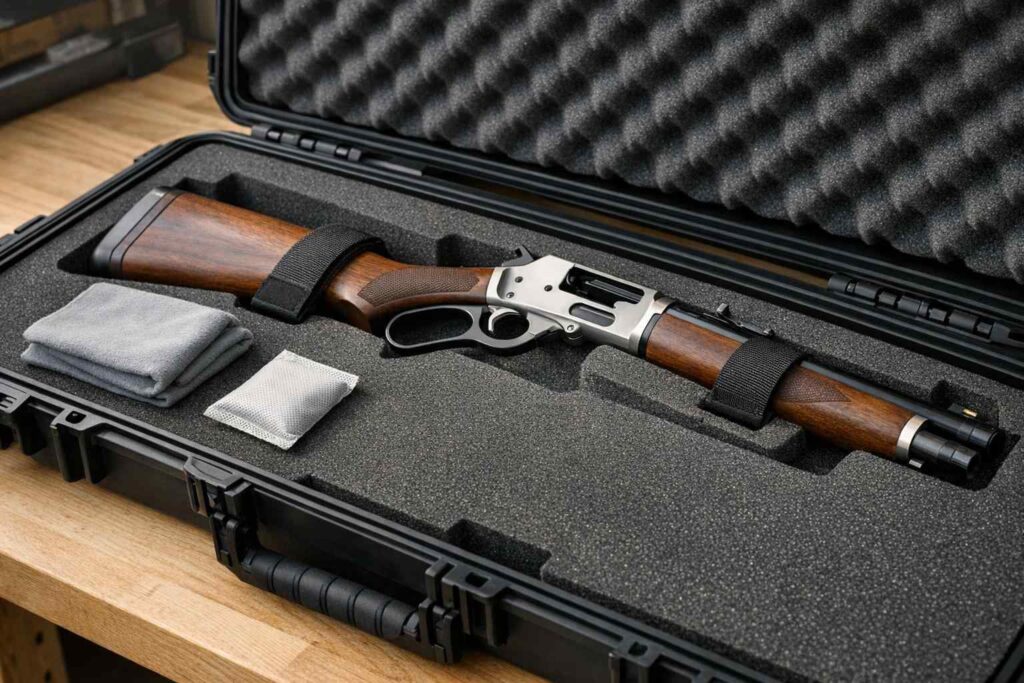
There is no need for a shooting rifle case to be elaborate. However poor design in relation to the lever, hammer, sights, sling attachments, etc. of the rifle can create a number of minor problems during transport. How well the damp padding in the case will protect the rifle during storage and how easy it will be to remove the rifle from the case are also important considerations. In the end the best case is one that provides good protection for the finish, does not allow any controls to be accidentally pressed or snagged, and is convenient for the way the rifle is carried and stored.
Start with the rifle's actual shape
Measuring the rifle in the storage position, with the lever closed, and removable accessories stowed away in accordance with the maker's instructions, forms the basis for selecting a suitable case. Whilst overall length may appear to be the principal factor to consider, features such as a pronounced pistol grip, enlarged loop, optical sight, hammer spur, and tall front sight all increase the overall width of the rifle and therefore demand additional internal space within the case.
You should look for contact points on the surface of the rifle before you purchase a case. Ideally the lever should not be pressed against the foam and the muzzle should not be pressed against the end of the case. If a rifle has a pronounced pistol grip or enlarged loop then it may need a case with extra room for these features. Measuring the overall length of the rifle is not enough – you also need to allow for any large optics or hammer spurs.
A little extra room for the firearm in the case is acceptable for careful placement, but no more space than that. The case should protect the rifle for scratches, but provide little or no protection for external knocks and pressure on the action.
The most vulnerable parts of the rifle need to be covered by the case, and there must be sufficient room for the longest part of the rifle. A scope on a rifle may need clearance above the action, or a large trigger loop could be placed in an open pocket in the case rather than in a tight space between the rifle and the case. A case for a rifle with a detachable sling will likely be much easier to store with the sling removed, and be less prone to wear on the sling hardware.
Match padding to the job
In terms of the material used for padding within a case's interior, there are two goals that must be achieved. Firstly, the padding must provide sufficient cushioning to absorb any impact that the rifle inside may experience. Secondly, it must stop the rifle from shifting about inside the case and causing damage to either the firearm itself or the case's internal surface. Many hard cases utilize thick foam that lines the internal walls and at the bottom of the case. This type of setup may appear to suffice, but in reality the foam pads are very easily compressed. A case with shaped internal areas, retaining straps, and other features to keep a firearm in place is a far better proposition than a large, poorly filled soft case with loose material.
Inside, inspect the case for exposed metal parts (e.g. fasteners), sharp edges or rough seams and where the zipper or other closures meet the case. Soft non-abrasive lining is preferred but even the softest case will collect small amounts of grime and require occasional cleaning, especially when used in vehicles, workshops or in range bags.
Retention straps need special attention. These need to keep control free and not press upon any other part of the gun – specifically the lever. If a strap is too short or too stiff or placed in such a manner to come into contact with the gun's finish then this can cause its own unique wear. Don't store the gun with removable accessories such as scope rings or sling fasteners still attached – follow the maker's maintenance guidelines.
The interior of a rifle case should allow the rifle to be placed in the case in a repeatable manner. The worst case is when a rifle has to be pushed to the side of the case to get past a hinge, pocket or divider. Look for cases where the foam collapses unevenly under the receiver and/or buttstock. Also look at hook-and-loop fasteners for looseness and for loose fibers that could stick to your rifle. These are minor details but very important when a case is frequently opened and closed.
Decide between hard case and soft case
This is to determine what kind of storage you will be needing for your rifle, in terms of potential hazards. As a frequent user of a vehicle for transportation of your firearm(s), the hard case would offer the best protection against potential damage. In storage, i.e. in a garage, basement, attic, etc., the hard case offers protection against crushing, such as by other items of equipment, or being knocked about. As you add more items to your storage collection, the potential for damage to your firearm(s) increases.
A soft case is lighter, easier to store and can be a lot easier to carry for short distances. This type of gun case is generally best suited to storing rifles in controlled environments such as in your home or in a workshop. A soft case does not provide as much protection from impact and also can be subject to squeezing and therefore pressure points.
A padded soft case is typically easier to transport and stow than a hard case, and may be more than sufficient for a traditional stocked rifle with modest optics. In these instances, a hard case can actually be counterproductive, serving only to add unnecessary weight, bulk, and awkwardness to your rifle case, and being far more likely to be discarded in a vehicle or storage room than a smaller, lighter soft case.
Be aware that hard cases require sufficient clearance within the case for the rifle to lie comfortably. Be sure that a tight seal does not mean that the rifle is pinched in some spot, for example, by the lid pressing against the lever, sight, etc. Conversely, soft cases should have outer fabrics and seams that do not sag around protruding sights, for example, and that the muzzle will not be forced against the end of the case.
Account for storage conditions
Some cases are designed for short, dry trips to the range and so do not have the same construction for longer periods in garages, vehicles, workshops, etc. The padding can get damp against the metal and then, once the rifle is taken out and allowed to return to room temperature, can squirt out and get wet and then dry out slowly in the case.
The firearm should always be stored unloaded, and refer to the makers storage guidelines as well as local and national safety and storage rules which can change at any time. In reference to local and national rules, check the official government site for the most up to date information on rules for storage and transport of rifles in your area.
Before storing your rifle in your protective case for an extended period, make sure any wet areas of the fabric or cushioning have been allowed to dry out completely. You should also try to regularly open and inspect the interior of your case, checking for any signs of wear and tear on the lining, any seams cracking and splitting, and any corrosion or wear on any of the case's hardware (straps, latches, buckles, etc.). If the case has a seal then make sure this is also clean and not damaged in any way.
Consider carrying details and accessories
The handles or shoulder straps, and external pockets on a rifle case determine how you will be to carry it. The handle(s) should be positioned so that they do not make the case unbalanced for the rifle. A shoulder strap is convenient, but be aware that it can drag on the ground and cause the case to hang in such a way that it could be damaged.
Be mindful of pocket space. Exterior pockets for slings, extra small parts and even gun documents can be a convenience, but they encourage over-stuffing of excess items that can even weight down against the rifle itself creating pressure points on the case as it is moved about. Keep accessories away from metal parts and store separately from the action. Never allow loose items to fall into the interior of the case such that they can reach and activate the trigger or affect the operation of the lever.
These should easily open and close, and you should be able to lift the case by its handle(s) and hear no other movement from inside the case. You will know that a fit that feels too tight when placing the rifle in the case for storage will become worse when in transit.
Inspect the fit before committing
When purchasing a case for your firearm consider taking it for a "test drive" before purchasing. Closed up carry the case as you would normally and simulate typical uses such as lifting and setting the case down. Check for any signs of wear or for the case to be put into awkward positions. Open up the case and check for any sign of wear or for the firearm to have been subjected to any undue stress.
Over time, the foam may compress, the retaining straps may loosen, and pressure points may form. Look for signs of wear after several uses and ensure the closure still functions properly. In the end, the best rifle case is not necessarily the most expensive or heavily padded. It is the case that will provide adequate protection in expected ways and still be used frequently.